Rat–human accord
The Amazing Maurice and His Educated RodentsThe Rat–human accord is the agreement that begins to replace Bad Blintz’s long conflict with The Clan with rules, negotiation, and mutual restraint. Its decisive significance lies in the difference between imagining that humans and rats might simply reconcile and creating a contract that can govern what they do next: neither side has to trust the other completely for both to recognize that renewed violence would bring the same conflict elsewhere.
From an ideal to a workable proposal
The agreement emerges against a contrast between two visions of cooperation. Dangerous Beans briefly considers Spider’s offer to cooperate in ruling the rat world, but tests what that alliance would mean by pointing to a hypnotized rat and asking whether she has thoughts of her own. Spider’s surprise makes the underlying problem plain: what he calls cooperation still treats other rats as instruments. Dangerous Beans concludes that the proposal would not work. His refusal distinguishes shared rule from domination dressed in cooperative language.
At the end of the story, Dangerous Beans offers a different image of possible relations between rats and humans. A story might end with the two groups shaking hands and entering a bright future; real life, he recognizes, requires a contract. The distinction sets the terms of the accord’s importance. A hopeful ending can express a desire, but the generations-long conflict between people and rats cannot be ended by a smile alone. It requires decisions, obligations, and details that both communities can contest and revise.
Maurice gives the mayor a preliminary picture of what negotiation could make possible. He imagines a town where people can address rats about food, and where the rats can answer and agree to leave the rest untouched. The example is a proposal, not a complete record of the final contract; its function is to make coexistence concrete. Instead of treating every rat as an intruder to be driven away, the town could establish a rule for sharing space and resources.
Negotiation and reciprocal restraint
Keith urges the mayor to speak with the rats and assemble the town council rather than rely on dogs, brooms, and temporary dispersal. Such measures, he warns, would only drive the rats away for a while before they returned. He also stresses the humans’ vulnerability: the rats live beneath their floorboards and know how to use fire and poison. The warning makes negotiation a practical necessity, not a sentimental appeal. Force can be answered, and pushing the rats out without changing the relationship leaves the cause of conflict intact.
Darktan presents the proposed conversation as an opportunity rather than a threat. Asked whether the rats can truly think and speak, he answers the mayor with a deliberately reciprocal challenge: the rats will pretend humans can think if humans will pretend rats can think. The remark exposes the presumption built into the old relationship, in which human recognition of rat intelligence is treated as something to grant. Yet Darktan frames the exchange as a starting point for dealing with one another, not as proof that either side already trusts the other.
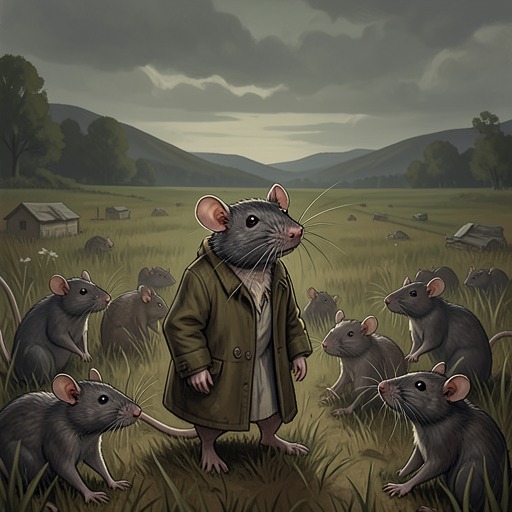
The mayor asks why the rats have not poisoned the town’s wells or set fire to its houses, since they owe the humans nothing and could retaliate. Darktan’s answer is strategic as well as ethical: killing people would not improve the rats’ situation, and simply moving to another town would begin the same dispute again. Sooner or later, the rats would have to talk to humans; it might as well be the people of Bad Blintz. The agreement therefore rests not on an assertion of friendship but on mutual recognition that neither revenge nor flight offers a lasting solution.
Making the agreement enforceable
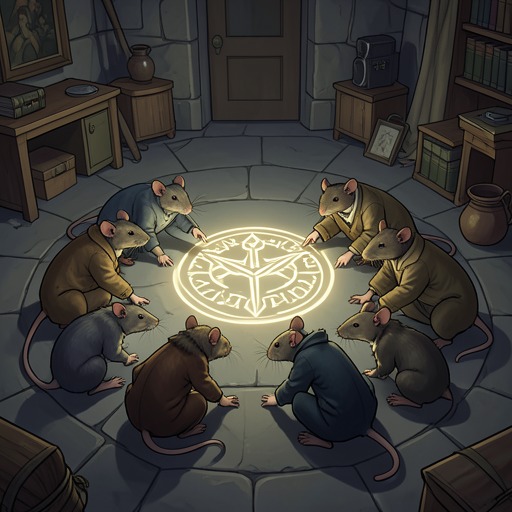
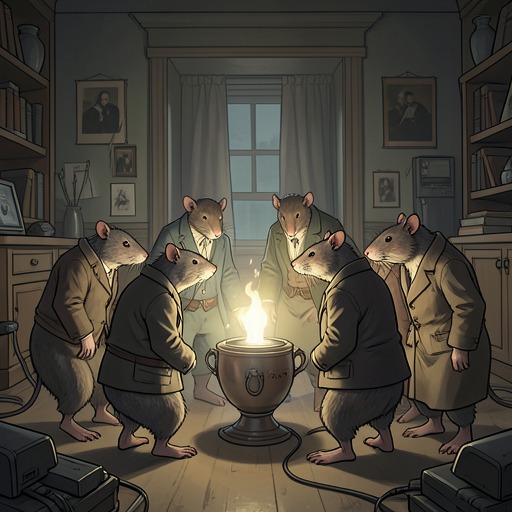
The proposed accord takes shape through a committee that includes the town council and most of the senior rats, with Maurice moving among the participants as they argue over details. The deliberations are prolonged and untidy; the narrative emphasizes that practical coexistence is not produced by a single declaration. One comic proposal concerns compulsory bells on cats, but the scene’s broader point is that rules must be discussed rather than assumed. Humans and rats have to work out how their shared arrangements will operate.
Darktan identifies concrete reciprocal limits: humans will not poison the rats’ cheese, and rats will not contaminate the humans’ jam. The arrangement also means an end to rat pits, traps, and poisons. It is not a promise that no rat will ever break a rule. Darktan anticipates having to explain to The Clan what a policeman is and why rat watchmen might pursue rats who violate the new Rules. The agreement thus entails obligations on both sides and some means of responding to breaches, even though those enforcement duties may be unpopular among the rats themselves.
The settlement’s practical reach appears in Bad Blintz’s street signs. Under clause 193, signs are to be written in both languages; Keith reads a rat-alphabet sign as Water, Fast, Stones, meaning River Street because rats perceive the cobbles as stones. Malicia notes that the clause was agreed only two hours earlier. The small, newly installed bilingual provision makes the change visible in ordinary civic life: the accord does not merely discuss coexistence in principle but begins to accommodate both communities in the town’s public language.
Significance and limits
Darktan thinks the arrangement might work precisely because the people and rats are still arguing. Agreement does not require the disappearance of disagreement; it gives disagreement a setting in which it need not become another cycle of poisoning, capture, and retaliation. The mayor’s question about why the rats did not attack also registers the imbalance and danger underlying the negotiation. The rats possess ways to threaten human homes, while humans have used traps and poisons against rats. The accord answers that history with reciprocal constraints rather than a claim that the two sides have become identical or fully trusting.
The settlement remains a beginning, not a guarantee. Darktan knows that the new rules will be difficult for The Clan to accept, and the evidence of the committee’s prolonged debate confirms that daily arrangements require continuing negotiation. Still, the alternatives are clear: leave for another town and reproduce the same conflict, or try to make shared life governable. In converting a possible handshake into a contract—with restrictions, civic participation, enforcement questions, and even bilingual signs—the Rat–human accord gives the story’s hopeful vision a form that real life can test.